Hey there! If you’ve ever had to spec out forklift tires for a warehouse, loading dock, or clean manufacturing space, you’ve probably heard “non-marking” thrown around like it’s some magic fix-all. And as someone who’s been selling non-marking forklift tires for the last 7 years (yep, I’m the guy on the other end of that chat when you Google “best non-marking tires for pallet jacks”), one question I get more than any other is: How do these things actually stack up when it comes to load capacity? Non Marking Forklift Tire
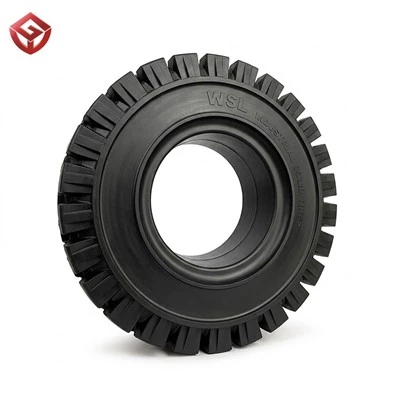
Let’s cut the jargon and get real here. A lot of people assume non-marking tires are flimsy, right? Like, just some fancy rubber that doesn’t scuff concrete but can’t hold a 5,000-lb pallet of bottled water. Newsflash—those days are long gone. Today’s non-marking tech is way different than the cheap white rubber you might’ve seen on a old toy forklift back in the 90s. Let’s break this down the way I do with every new customer: not just specs, but what actually works when you’re hauling heavy loads at 2 a.m. in a busy warehouse.
First, let’s do a quick refresher on what makes a tire “non-marking” to begin with. It’s not just the color—though most are white, light gray, or a pale blue that doesn’t leave dark rubber skid marks on epoxy, concrete, or polished floors. The real secret is the rubber compound. Regular forklift tires are made with a hard, carbon-black rubber that’s tough for heavy loads. Non-marking tires swap that carbon black out for other additives—like titanium dioxide, natural silica, or different polymers—that give you that light color without losing the strength to hold weight. That’s the balance everyone’s chasing, right? You don’t want a scuffed-up floor, but you also don’t want a tire blowing out mid-pick of a full pallet of steel parts.
Now, load capacity—this is where it gets specific, because it’s not one-size-fits-all. Let’s split this into two main types of non-marking forklift tires, since that’s what most operations use: solid pneumatic non-marking tires and solid press-on (also called press-fit or cushion) non-marking tires. I see so many customers mix these up, so let’s clear that up fast.
Solid pneumatic non-marking tires are the ones that look like regular forklift tires but are solid (no air inside) and made with that non-marking compound. These are usually used for indoor-outdoor use, like moving pallets between a warehouse and a loading dock that’s got some rough concrete. A standard solid pneumatic non-marking tire for a 5,000-lb capacity forklift? Its load rating is basically identical to a regular black solid pneumatic tire of the same size. Let’s pull a real example here: a 15x5x10 solid non-marking tire I stock for most standard 3,000-5,000 lb forklifts has a load capacity of around 3,200 lbs per tire at 10 mph (that’s the typical speed for a forklift indoors). A regular black tire of the same exact size? Same load number. No difference. The only tradeoff? A tiny bit of rolling resistance, which means you might use a touch more battery power, but for most warehouses, that’s negligible compared to not scuffing the floor or needing to replace tires every 6 months.
Then there are solid press-on non-marking tires—these are the ones that fit right onto the forklift’s steel rim, no inner tube or air, and you just press them on. These are the workhorses for indoor use, especially in clean rooms, food processing plants, or retail warehouses where floor cleanliness is non-negotiable. This is where I hear the most skepticism, because press-on non-marking tires used to be wimpy. Not anymore. Take a common press-on size, like 8.25×4, which fits most 3,000-4,000 lb forklifts. A standard black press-on tire of that size has a load capacity of around 4,500 lbs. A non-marking press-on in that same size? 4,300 lbs. That’s only 200 lbs less per tire—less than 5% of the total load. For a full set of 4 tires, that’s an 800 lb total difference. But wait, when would you ever need that extra? Most standard forklifts aren’t hauling 18,000 lbs around every day. That 200 lb gap is enough to cover the occasional heavy pallet, and if you really need more, we have heavier-duty non-marking press-ons. For example, a 18x5x12.5 non-marking press-on (for 10,000 lb forklifts) has a load capacity of 10,100 lbs per tire. The regular black version? 10,300 lbs. Again, tiny difference. That’s because the tech’s gotten better—they don’t skimp on the rubber’s tensile strength anymore just to keep the color light.
Wait, but what about foam-filled non-marking tires? Yeah, those are another popular type, especially for warehouses that have to deal with nails, sharp debris on the dock, so they can’t have flats. Foam-filled is when you pour solid foam inside a tire so it never goes flat, even if you run over a screw. A lot of customers ask if those have lower load capacity. Let’s be honest—they do, but not by much, and only compared to solid pneumatic non-marking, not regular foam-filled black tires. A 15x5x10 foam-filled non-marking tire? Load capacity around 2,800 lbs per tire, vs. 3,200 lbs for a solid pneumatic. But that’s still enough for most 5,000 lb capacity forklifts—since you distribute that load over 4 tires, that’s a total capacity of 11,200 lbs, which is way more than the average pallet you’re moving. The tradeoff here is durability: foam-filled tires are a bit stiffer, so they handle rough surfaces better than pneumatic, but they don’t give as smooth a ride. Again, no big hit to load capacity that matters for daily use.
Now, let’s talk about the stuff that does actually affect load capacity, because this is where most customers get confused, and it’s not the tire compound. It’s size, inflation (for pneumatic, obviously), and tread pattern. A lot of people see a white non-marking tire and assume it’s smaller than it is, but size is the biggest factor in load capacity, not color. A 20x8x15 tire, regardless of if it’s black or white, is gonna hold way more than a 15x5x10. Inflation pressure for pneumatic non-marking? Same rule as regular tires: underinflate, and load capacity drops hard. If you run a pneumatic non-marking tire at 20 psi instead of the recommended 30, you might lose 10-15% of its load capacity, same as a black tire. Tread pattern too—deep, aggressive tread for outdoor use will hold less weight than a smooth or semi-smooth tread for indoor use, because the rubber contact patch is smaller. That’s true for every tire, marking or not.
But here’s the thing where non-marking tires actually have an edge over regular black tires—wait, did I just say that? Yeah, sometimes. Because of the rubber compound, non-marking tires have better tear resistance in some cases, especially when it comes to sharp, smooth floors. If you’re driving a forklift over polished concrete with small debris, a non-marking tire’s silica compound is less likely to tear than a carbon black rubber tire. That means less downtime from flat tires, which is basically a win for load capacity over time—you don’t have to take a tire out of service halfway through a heavy shift.
Now, let’s get real about the myths that bug me the most. First myth: Non-marking tires are only for light loads, like pallet jacks. Nope, we’ve got non-marking tires for 12,000 lb capacity forklifts, no problem. Second myth: The load capacity is way lower, like 30-40% less. That was true 15 years ago, back when non-marking compound was still new. Today, it’s more like 3-7% less, which is negligible for 90% of operations. Third myth: Color doesn’t matter for load. That’s true, but color does matter for your facility. If you run a food plant, you can’t have black rubber marks getting into product. If you run a high-end retail warehouse, scuffed floors look bad for customers who walk through. That’s why people choose non-marking, and now you don’t have to give up load to get that benefit.
Wait, let’s test this with a real customer story, because I hate just throwing specs at people. Last year, we had a customer who runs a big frozen food warehouse—they needed non-marking tires because epoxy floors can’t have any scuffs (their facility has monthly inspections for OSHA and food safety rules). They were using regular black press-ons before, but every 3 months, they’d have to replace 2 tires because they’d tear from driving over frozen cardboard and pallets. They were nervous to switch to non-marking because they thought their 6,000 lb capacity forklift would have issues. We sold them the 8.25×4 non-marking press-ons, and their load capacity per tire is 4,300 lbs, so total for 4 tires is 17,200 lbs—way more than their max load of 12,000 lbs. A year later, they called to say they haven’t had a single scuff, no floor violations, and they only replaced the tires once in 12 months, vs. every 3 months before. The small load capacity difference was nothing compared to the cost savings from less downtime and compliance.
Is there a case where non-marking tires can’t handle a load? Sure, if you’re trying to haul 20,000 lbs with a 5,000 lb forklift, even a regular black tire can’t handle that. Same thing here. If you need heavy-duty, high-capacity forklifts, you just get the bigger size non-marking tires, same as you would with any other tire. The only time I see people struggle is when they buy the cheapest non-marking tires from no-name brands that cut corners on compound. You go for a cheap white tire off Amazon, and yeah, it’s gonna be flimsy, low load capacity, fall apart fast. But when you go with a reputable brand (and that’s us, fyi), the load capacity is basically on par with regular tires.
So, to wrap this up for anyone still wondering: Non-marking forklift tires’ load capacity is almost identical to standard black tires of the same size and type. The difference is minimal, usually less than 10%, and only a factor if you’re pushing your forklift to its absolute limit. The real tradeoff is nothing compared to the benefits of clean floors, compliance, and less tire-related downtime. If you were holding back from switching to non-marking because you thought you couldn’t haul heavy loads, don’t—today’s tech has solved that problem.

If you’re ready to stop worrying about scuffed floors and want to spec non-marking tires that can handle your loads, hit us up anytime. We’ll walk through your forklift size, max load, and environment to hook you up with the right tires—no sales pitch, just straight talk.
Solid Tire References
The Tire Industry Association. (2022). Forklift Tire Load Capacity Standards.
Industrial Tire and Rim Association. (2021). Non-Marking Tire Compound Performance Guidelines.
OSHA. (2020). Warehouse Material Handling Equipment Safety Standards for Tires and Flooring.
Zhejiang Guowei Rubber Co., Ltd.
Zhejiang Guowei Rubber Co., Ltd. is one of the most professional non marking forklift tire manufacturers and suppliers in China. With abundant experience, we warmly welcome you to buy advanced non marking forklift tire in stock here and get pricelist from our factory. Quality products and reasonable price are available.
Address: No. 10, Nanyang 4th Road, Duqiao Town, Linhai City, Taizhou, Zhejiang Province, China
E-mail: gwsolid@gmail.com
WebSite: https://www.forkliftsolidtires.com/
